Cloudy Skies
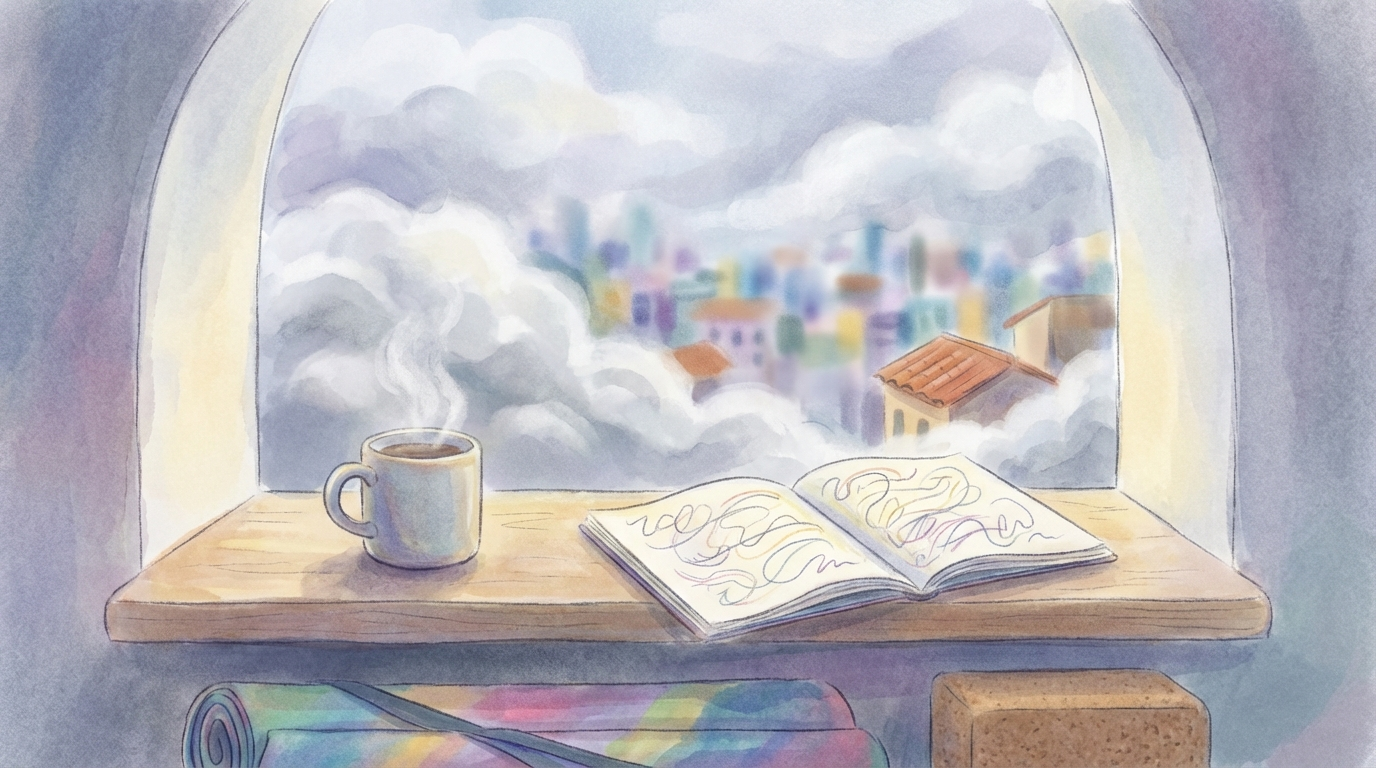
This morning in Lisbon, I woke to darkness and cold. The sky outside matched something inside me, something gray and undefined. I rolled onto my yoga mat, settled onto my block, and tried to meditate. Ten minutes in, the cloudiness hadn't lifted. It had only become more apparent.
So I stopped. I got up and reached for my journal instead.
There was no plan, no intention to capture anything profound or worth keeping. I just started writing. The pen moved faster than my thoughts could arrange themselves into coherent sentences. After five minutes, I realized I couldn't even read my own handwriting.
This should have bothered me. The whole point of keeping a journal, I'd always assumed, was to preserve something. To document. To create a record I could return to later and mine for insights or track patterns over time.
But this wasn't that kind of writing at all.
The illegibility felt like a feature, not a bug. I was writing to no one, not even to my future self. The words were leaving my mind and traveling through my hand onto paper, but they weren't meant to arrive anywhere. They were just meant to move.
It reminded me of conversations I've had with close friends, the kind where we talk for hours and afterward I can barely remember what was said. The content dissolves almost immediately. What remains is just the feeling of having been heard, of having let something out into the air between us.
My journal that morning became a kind of conversation partner who asks nothing of me and remembers nothing. The privacy was absolute, more complete than any other form of privacy I know.
When I talk to my partner, there's love there, but also the reality of being known. She remembers things I've said. She notices patterns. She cares about what I'm going through, which means my words carry weight and consequence.
With a therapist, there's professional distance but also professional attention. Every word is being received, considered, potentially analyzed. Even the act of speaking to an AI feels like it creates some kind of record, some trail of data that exists somewhere.
But this scribbled, unreadable writing existed in a space beyond even my own judgment. I couldn't go back and critique it later because I couldn't read it. I couldn't ruminate on whether I'd expressed myself well or badly. The words were gone almost as soon as they appeared.
I've been doing some version of this practice on and off for ten years, ever since I encountered Julia Cameron's Morning Pages in The Artist's Way. Her version is more structured than mine has become. Three pages, first thing in the morning, stream of consciousness.
Over the years, the practice has shifted and adapted. Sometimes I write three pages, sometimes half a page, sometimes ten pages. Sometimes in the morning, sometimes at night when insomnia finds me. The form has become less important than the function.
What I'm really creating is a space where vulnerability doesn't require courage. Where I can be messy and unclear and contradictory without having to make sense or be fair or consider how I sound.
I am, without question, my harshest critic. The judgment I fear most doesn't come from others. It comes from the voice in my head that watches everything I do and finds it wanting. That voice is relentless and often unkind.
But it can't critique words it can't read. In the speed and illegibility of my morning writing, I've found a strange loophole, a way to express myself that exists beneath the threshold of my own self-consciousness.
After ten minutes of writing that morning, I noticed the internal weather had changed. The cloudiness that had interrupted my meditation was gone. I felt clearer, lighter. My body had relaxed in ways I hadn't noticed it was tense.
The remarkable thing was that I couldn't even remember what the clouds had been about. What had felt so heavy and present just minutes before had completely evaporated. I had no idea what I'd written, what I'd been worried about, what had needed expressing.
Nothing in my external circumstances had changed. The Lisbon sky was still dark. The apartment was still cold. My to-do list was the same length it had been when I woke up. No problems had been solved, no decisions had been made.
But the way I felt inside had transformed completely. And that shift, that change in my internal landscape without any change in external conditions, felt like a kind of power.
There's something deeply reassuring about discovering that I can alter my experience of the world through such a simple act. That I don't need anything to be different out there for things to feel different in here.
The practice has become a kind of maintenance for me, like brushing my teeth or stretching. A way to keep my mental and emotional systems clean, to release whatever accumulated overnight or built up during the previous day.
I think about how much energy I spend trying to change external circumstances. Trying to make things happen or not happen, trying to influence how others see me or what they do. All that effort directed outward.
This kind of writing requires almost no effort at all. Just a notebook, a pen, and the willingness to let words spill out without trying to catch them or make them into something.
When the clouds clear and the sun shines through, the beauty I feel inside has nothing to do with achievement or validation or getting anything right. It's just the relief of having let something go, of having created space where there was congestion.
I'll return to this practice tomorrow morning, and the morning after that. Not because I'm trying to build a streak or maintain a habit, but because I know now what it feels like to wake up cloudy and write my way to clear skies.
And because sometimes the most private conversations are the ones where nothing is remembered, nothing is kept, and the words disappear as soon as they're written.