Postcard
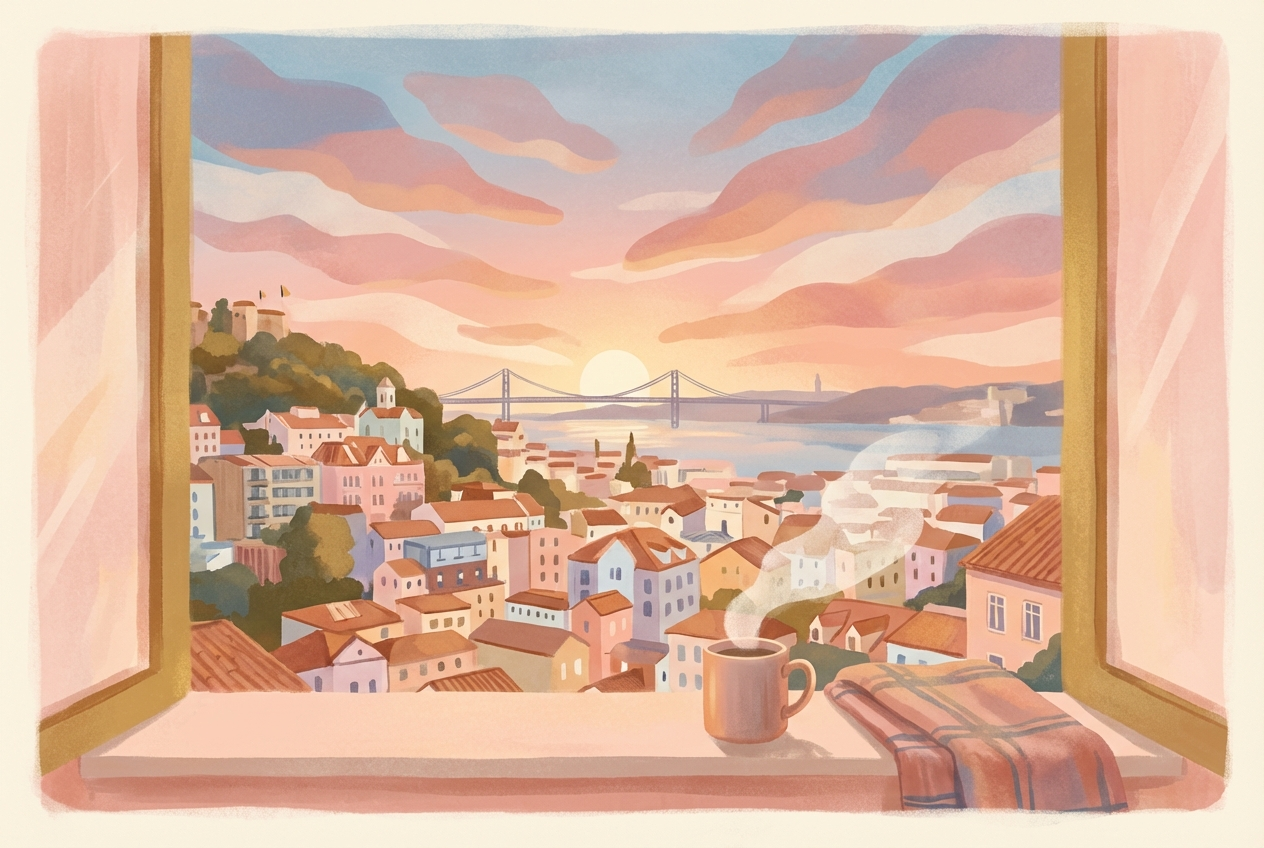
Winter in Lisbon means I wake up before the sun does. Our apartment is still dark, and outside, the city sleeps under a blanket that hasn't yet decided to lift. I've spent the past two winters in Australia, so being back in Portugal feels like returning to a ritual I'd almost forgotten existed.
From my window, I get to watch the sky prepare itself. Candy floss clouds gather and shift, waiting. The sun peeks from a corner it doesn't occupy in summer, offering these small glimmers of itself before committing to the full reveal.
My energy shifts as the light begins to arrive. Something rises inside me that mirrors what's happening outside. The temperature climbs, the darkness retreats, and I'm left sitting in this warmth with my ginger tea, looking out at a view that people tell me is extraordinary.
Our apartment sits at the top of a hill in the middle of the city, which creates this peculiar effect of height. From here, I can see thousands of buildings spread across Lisbon, the river, the bridge, mountains in the distance, but no streets. Not a single road is visible from where I sit. This particular angle means the building itself is invisible from below, a secret suspended in the air that exists only for those who climb the hill and step inside.
Visitors often tell me that I live in a postcard. They mean it as a compliment, and it is one. The view looks like something sold at tourist shops throughout the city on small hand-sized pieces of card stock, the kind of image that captures what people imagine when they think of Lisbon, of Europe, of a life different from their own.
But here's what I've learned after four years with this view: I forget. I forget that this is supposed to be special. I walk these streets that my North American friends find enchanting, and they're just streets to me. The view from my window becomes wallpaper. The postcard stops being a postcard the moment it becomes my everyday reality.
A postcard only exists in relation to something else. It requires contrast. Without comparison, without the memory of somewhere different or someone else's fresh eyes seeing it for the first time, the extraordinary becomes ordinary. The special becomes standard.
This realization has shifted something in how I think about difference itself. Most of the time, difference registers as negative in my body. The hotel bed that isn't mine. The restaurant food that doesn't match what I wanted. The way my shoulders feel tighter than usual, my lower back a little off.
I mentally catalog these differences throughout my days, my weeks, my year. And my first reaction is almost always resistance. This isn't what I'm used to. This isn't what I prefer. The unfamiliar triggers something defensive in me, something that wants to retreat to the known.
But sitting here watching the winter sunrise, I'm understanding that difference serves a purpose beyond discomfort. The purpose of difference is to remind me of what I have. When something shifts, when the familiar becomes unfamiliar even briefly, I'm given the opportunity to see what was there all along.
It's not enough to notice what's wrong with the thing that's different. That's where I usually stop, in that place of complaint or annoyance. The practice is in taking it one step further, in asking what the contrast reveals about what I've been taking for granted.
The hotel bed reminds me of my own. The restaurant meal points back to the food that nourishes me at home. The tension in my body highlights the moments when it feels easy and fluid. Every difference is a mirror held up to what I've stopped noticing.
This is why I like having visitors. They arrive with fresh eyes and see postcards everywhere. They enter our apartment and gasp. They look out the window and pull out their phones. They remind me to look again at what I've learned to overlook.
It's not about the objective grandness of anything. My view isn't better or worse than other views. Our apartment isn't more or less valuable than other homes. That's not the point, and it never was.
The point is learning to see the beauty in what is. Not what could be, not what should be, not what exists somewhere else in someone else's life. Just this, just now, just what's actually here in front of me when I remember to look.
I think about expectation and how it functions in my life. Every expectation carries within it the seed of disappointment. When I expect things to be a certain way, I'm setting up a measurement, a standard against which reality will inevitably fall short sooner or later.
Disappointment lives in my body as tension. It deflates me, drains my energy, leaves me feeling smaller than I was before. I can feel it in my chest, this collapse inward, this sense of something being taken away.
Gratitude does the opposite. Appreciation lifts something in me that affects not just my own experience but the space around me. It's infectious in the way disappointment never is. It generates energy rather than depleting it, creates possibility rather than closing it down.
So I invite people in. I let them exclaim over the view, over the neighborhood, over the light that fills the rooms at different times of day. Their wonder becomes a gift they probably don't know they're giving me.
They help me remember I live in a postcard. And this remembering is crucial because without it, I slip into a kind of blindness. I start to believe that this is just how things are.
The sunrise this morning was pink and orange and gold. The clouds shifted and the light changed and the city below began to wake. I sat with my ginger tea getting cold and watched the whole thing unfold.
I need these reminders. I need the contrast, the visitors, the returns after time away. I need difference to show me what sameness has hidden. The postcard was always there, waiting for me to see it again.