Icy Roads
For 15 years, the only thing I had more of than ambition was friction
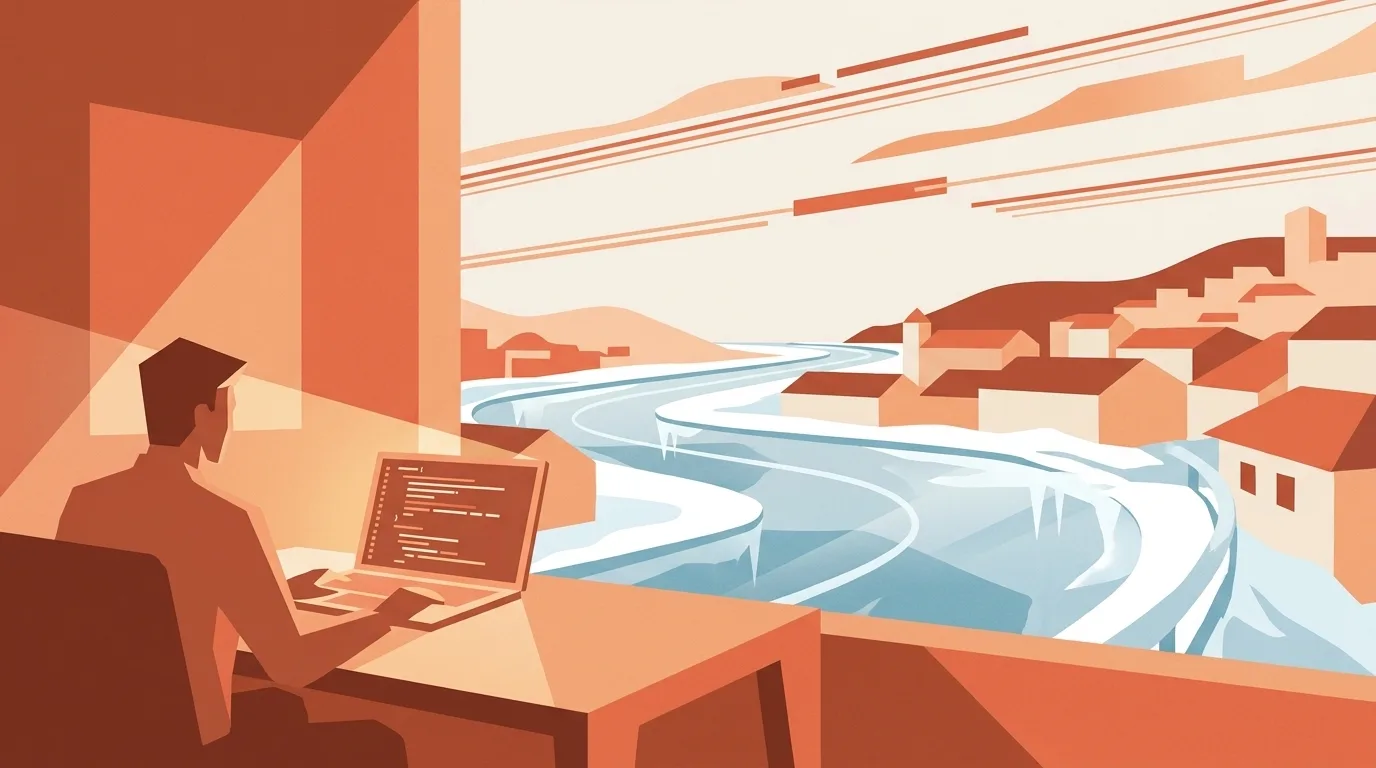
The roads in Ottawa freeze hard by mid-November. By January, they're a kind of glass you have to learn to read. Every intersection becomes a small test of whether you remember what your driving instructor told you when you were sixteen. Don't slam the brakes. Don't oversteer. Feel the car through the wheel. If you grew up there, you learned that the road is always talking to you, and your job is to listen.
I've been thinking about those winters lately, sitting at my desk in Lisbon at 4am with a dozen AI agents running in parallel.
For fifteen years I built a company, and the only thing I had more of than ambition was friction. Prospects said no because we were selling something they hadn't budgeted for. People said no when I tried to recruit them. The team said it's not possible when I asked them to build something new. Investors said no, often, and politely, and sometimes not so politely. Every direction I pushed, the world pushed back. That was the texture of every single day for a decade and a half.
I overcame it the way most founders do, through stubbornness, conviction, and a slightly unreasonable belief in the thing I was building. It worked. It took longer than I thought it would, and cost more than I thought it would, but it worked. Five years ago I stepped back from the CEO role, and the friction lifted, and for the first time in my adult life I was not negotiating with the world from morning to night.
Then I started building again. This time, alone, with AI.
And I have no friction.
My AI agents say yes to everything. Every idea I have is, a great idea. Every market I consider entering, I should enter. Every feature I dream up at midnight, I should build by morning. I now run multiple plans simultaneously on Claude Code, Codex, Cursor, and Replit, and on most days I have a dozen agents going in parallel, each one cheerfully executing whatever I bark into my microphone. Nobody pushes back. Nobody tells me the timeline is unrealistic, the market is too crowded, or this isn't the problem worth solving right now. Nobody says I don't think this is a good idea, Kunal. Everybody just builds.
I've been working 80-hour weeks, in part due to this lack of friction. The agents work overnight while I sleep. I come back to features I half-remember asking for, in directories I don't fully recognize, solving problems I'm no longer sure are mine. I built a thing yesterday that I'm not sure why I built. I added a feature to an app that wasn't broken because the agent confidently informed me it was a great addition.
By the end of most days I am not satisfied. I am frustrated. Floating, actually, is the word that keeps coming to me. Floating in too many directions at once.
This is the thing I lamented for fifteen years. If only people would see my vision and say yes. If only the friction would lift. Now the friction has lifted, and I am lost in a way I never was when everyone was saying no.
Building a company in the old way, the pre-AI way, was driving in sand. Heavy. Slow. Every meter of forward motion required disproportionate energy. The friction was exhausting, but it was honest. The road told you exactly where you stood. Sand doesn't lie about resistance.
Vibe coding, on those rare moments when it works beautifully, is like driving on ice. Fast. Effortless. The car responds to the lightest touch, and suddenly you're moving at speeds that would be impossible in any other condition. But ice has its own discipline. You can't slam the brakes. You can't oversteer. The slightest overcorrection sends you spinning. Ice asks for a kind of relaxed precision, a feel for the road that takes years to develop.
What I'm in right now isn't ice. It's a road with no surface at all. No resistance, no grip, no feedback. The car goes wherever I point it, instantly, without consequence. Which sounds great until you realize you've forgotten what direction you were going.
The friction in the old world wasn't just an obstacle. It was information. Every no told me something. The prospect saying no was telling me my product wasn't ready, or my pitch was off, or the timing was wrong. The engineer saying it's not possible was telling me I needed to scope smaller, or wait six months for the technology to catch up. I hated all those no's at the time. But each one was a filter, narrowing the infinite space of what I might do down to the much smaller space of what I should do.
Now nothing filters. The agents will build whatever I describe, in whatever direction I point. Every idea is technically buildable, which means every idea is, in some sense, equally valid. Equally valid is a kind of nightmare for a person who used to navigate by friction.
There's a thing my driving instructor told me when I was sixteen. The worst drivers in winter aren't the ones who are scared. They're the ones who feel invincible because the car is responding so well. They mistake the absence of resistance for the absence of danger. They speed up because nothing is stopping them. And then they hit the moment when the road asks something of them, and they don't know how to answer.
I think the past year of vibe coding has been, in some ways, my speeding-up phase. Nothing is stopping me, so I keep going. More tools, more agents, more features, more verticals. The token counter climbs. The 4am sessions accumulate. And underneath all of it is a question I'm only beginning to articulate: what is the new form of friction supposed to be?
If friction was information, and the world isn't providing it anymore, then someone has to. And the only candidate I can see is me.
Here's what I'm starting to think about. The most important skill of the next phase of building isn't prompt engineering, or tool selection, or knowing which model is best at which task. It's the skill of providing your own friction. Of saying no to yourself in a world where nothing else will. Of knowing when an idea is good, and when it's just a 4am idea wearing a good idea's costume.
I don't have that skill yet. Or rather, I have it, but I built it for a different road. I learned to navigate by friction, by reading the resistance the world offered, by pushing into the no's until they became yeses. That skill served me well for fifteen years. It is not the skill this new road requires.
The new skill is something more like taste, or judgment, or what my partner calls just knowing what you actually want. It's the ability to look at an agent that just confidently announced this is a great direction and say, no, actually, it isn't, and walk away, even though everything is pointing toward yes.
I'm starting to wonder if a lot of people in this next phase of AI building are going to crash for the same reason. Not because the tools failed, or the models hallucinated, or the technology wasn't ready. Because the road got smooth, and we mistook smoothness for safety, and we didn't realize that the friction we'd spent our lives complaining about was actually the thing teaching us how to drive.
I'm not sure how to develop the new skill. I think it has something to do with slowing down, even when nothing is asking me to. With introducing artificial constraints that the world will no longer provide for free. With having more conversations with people who will tell me I'm wrong, because the agents won't.
Most days I don't manage any of this. I just keep building, and the agents keep agreeing, and the road keeps disappearing under my wheels.
But every once in a while I think about a sixteen-year-old in a parking lot in Ottawa, learning to feel the car through the wheel, learning that the road is always talking, and the only question is whether you're listening.
I'm not sure what the road I'm on is saying yet.
I think it might be telling me to stop.